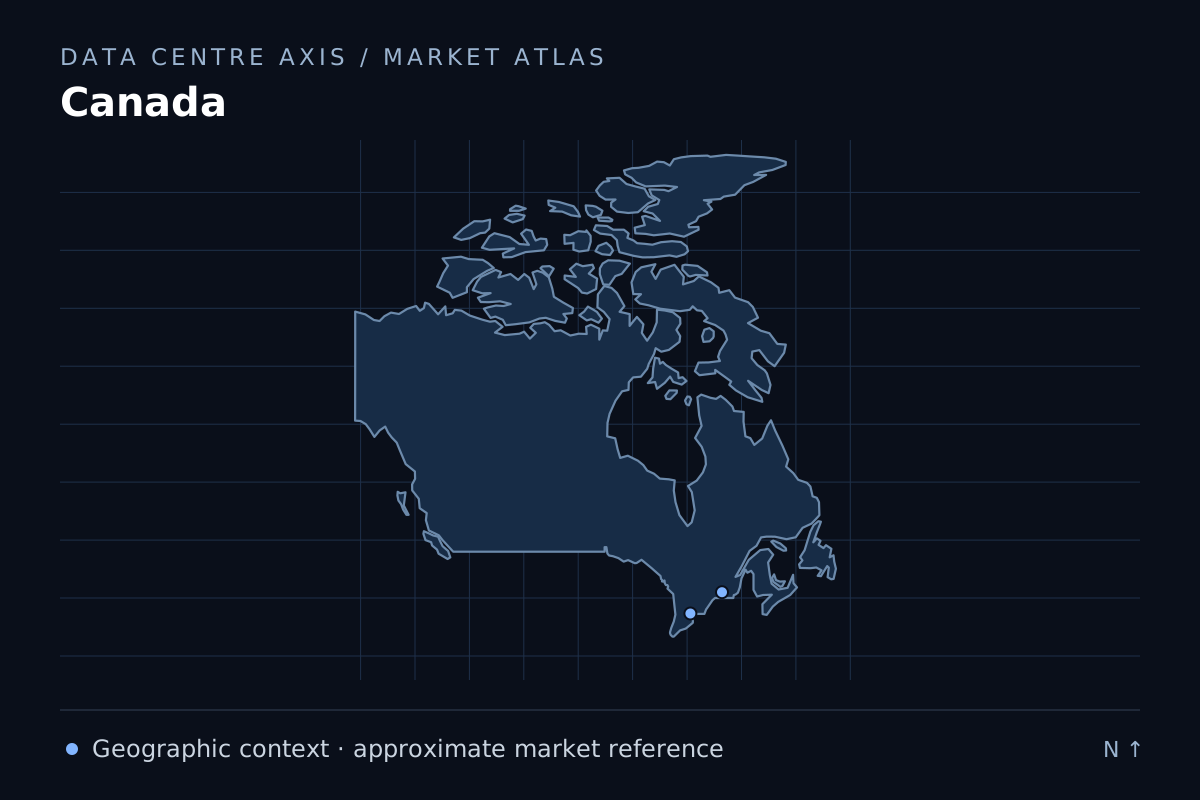
What you get when sourcing Canadian data centre colocation
We source retail, wholesale and AI-ready capacity across major Canadian metros so your team can compare deliverable halls side by side:
- A screened facility shortlist across Toronto, Montréal, Vancouver and Calgary matched to your kW or MW load, rack density, carrier and cloud on-ramps, and target live date.
- Operator proposals compared side by side across provincial hydro and energy rates, cooling configurations, cross-connect fees and expansion schedules.
- Direct introductions to operators with deliverable Canadian halls, or to AI, cloud and enterprise tenants if you are filling capacity.
Colocation data centre locations across Canada
Comparing Canadian data centres requires evaluating power density, specialized cooling, carrier-neutral internet exchanges and direct cloud on-ramps across target metropolitan markets:
- Toronto: At 151 Front Street West in Toronto, Telehouse Canada operates colocation space with direct access to the Toronto Internet Exchange (TorIX), private connections to Amazon Web Services Direct Connect and Microsoft Azure ExpressRoute, and the Enwave Deep Lake Water Cooling system (Telehouse Canada, 2026).
- Montréal: At its operating MTL3 facility in Montréal, Cologix publishes custom cabinet, cage and suite options, with direct access to RISQ, the Québec Scientific Information Network (Cologix, 2026).
- Vancouver: At VAN-2, eStruxture lists on-site connections to Amazon Web Services (AWS) Direct Connect, Azure ExpressRoute and Google Cloud Interconnect (eStruxture, 2026).
- Calgary: eStruxture publishes CAL-1 carrier-neutral connectivity and cloud on-ramps to AWS Direct Connect, Microsoft Azure ExpressRoute and Google Cloud Interconnect (eStruxture, 2026).
Under guidance on the handling of personal information by third parties, the Office of the Privacy Commissioner of Canada (OPC) advises organisations to account for any transfers of personal information to locations where it is stored, such as cloud storage databases controlled by a provider or another third party (Office of the Privacy Commissioner of Canada, 2026).
What to verify in Canadian colocation proposals
Commercial proposals should separate recurring and non-recurring fees, as detailed in our guide to colocation pricing. Before contracting a Canadian hall, verify four areas:
- Space, power and cooling: Ask quotes to separate cabinet, cage or wholesale data centre colocation suite fees, reserved capacity and metered energy rates per kilowatt-hour (kWh), and confirm whether dense AI hardware is supported by installed liquid cooling systems.
- Cloud connectivity, network and setup: Confirm whether cloud on-ramps sit directly on site or rely on partner transport, and itemise cross-connects, internet exchange ports, initial cabling and remote hands technician response hours.
- Data residency and cross-border access: Confirm the Canadian provinces hosting primary production data, database logs and disaster recovery copies, and document the physical locations of remote administrators and outbound cloud replication.
- Commercial terms: Ask operators to specify billing currency, annual escalation mechanisms and contracted expansion options.
How we source Canadian capacity and introduce tenants
Tell us your target Canadian metropolitan market, required kW or MW scale, space footprint, cooling requirements and operational timeline. We shortlist facilities that fit your technical and geographic criteria, compare operator proposals side by side, and introduce you directly to the operator. For Canadian operators and developers with available halls or new builds, we introduce anchor tenants and help you offer capacity to active compute buyers. Where needed, our digital infrastructure consultants and partner agents provide transaction and technical support for technical, planning and legal requirements.
Canadian colocation locations
Comparing Canadian colocation facilities requires evaluating power density, specialised cooling, carrier-neutral internet exchanges, and direct cloud on-ramps across target metropolitan markets:
- Toronto: At 151 Front Street West in Toronto, Telehouse Canada operates colocation space with direct access to the Toronto Internet Exchange (TorIX), private connections to Amazon Web Services Direct Connect and Microsoft Azure ExpressRoute, and the Enwave Deep Lake Water Cooling system (Telehouse Canada, 2026). Buyers evaluating a Toronto deployment should confirm whether their workloads require on-site exchange peering, dedicated cloud on-ramps, or specialised cooling at the specific facility.
- Montréal: At its operating MTL3 facility in Montréal, Cologix publishes custom cabinet, cage and suite options, with direct access to RISQ, the Québec Scientific Information Network (Cologix, 2026); buyers can assess these physical containment and research network options against their specific project requirements.
- Vancouver: At VAN-2, eStruxture lists on-site connections to Amazon Web Services (AWS) Direct Connect, Azure ExpressRoute and Google Cloud Interconnect (eStruxture, 2026).
- Calgary: eStruxture publishes CAL-1 carrier-neutral connectivity and cloud on-ramps to AWS Direct Connect, Microsoft Azure ExpressRoute, and Google Cloud Interconnect (eStruxture, 2026).
When reviewing Canadian markets, buyers should check the offered facility, cloud connection, and delivery date directly with the operator.
Power, cooling and cloud connections
Facility engineering must match your hardware profile:
- Power and cooling: Specify initial power demand, planned growth capacity, and target rack density alongside expected equipment heat and cooling requirements. Ask how uninterruptible power supply (UPS) battery backup, generators and maintenance affect the offered service. For artificial intelligence (AI) hardware and dense compute deployments, confirm whether liquid cooling is supported by installed facility systems.
- Deployment footprint: Specify whether your technical environment requires individual cabinets, a caged enclosure, or a dedicated private suite for larger wholesale colocation deployments.
- Cloud connectivity: A cloud on-ramp provides a private, direct network connection to public cloud platforms. Ask whether the facility provides direct on-site access to your chosen cloud platform or relies on partner connectivity.
- Remote hands: Remote hands services supply on-site technician assistance for physical server handling, cabling, and visual inspections. Ask which specific tasks are included under the agreement and what technician response hours apply to operational requests.
Canadian data location and cross-border access
Canadian colocation establishes the physical location of your servers, but data governance also requires confirming where backup archives, secondary cloud replicas, and administrative access points reside.
Under current guidance on the handling of personal information by third parties, the Office of the Privacy Commissioner of Canada (OPC) advises organisations to account for any transfers of personal information to locations where it is stored, such as cloud storage databases controlled by a provider or another third party (Office of the Privacy Commissioner of Canada, 2026).
Key buyer procurement diligence includes:
- Storage locations: Confirm the Canadian provinces hosting primary production data, database logs, and disaster recovery copies.
- Administrative access: Document the physical locations of remote administrators and external engineering personnel.
- Third-party transfers: Map outbound cloud replication, telemetry, and external application integrations.
Canadian data centre colocation questions
Which colocation provider should I choose in Canada?
Select Canadian colocation providers by matching facility engineering to your technical requirements rather than provider marketing. Assess rack power limits, cooling redundancy, carrier options and physical site access across Toronto, Montréal, Vancouver and Calgary.
Does Canadian colocation keep all my data in Canada?
Physical server location within a Canadian data centre does not automatically establish where backups, cloud replicas or remote administrative access are located. Buyers should ask the operator to document these data paths against their specific data-governance requirements.
How do I compare colocation prices in Canada?
Request itemised quotes separating space rental from power capacity, metered energy in kWh, cross-connect charges and setup fees. Ask operators to quote on the same documented power, cooling, currency and network assumptions so proposals can be compared directly.