What you get when sourcing US data center colocation
We source retail, wholesale and AI-ready capacity across major US metros so your team can compare deliverable halls without canvassing every operator separately:
- A screened facility shortlist matched to your kW or MW load, rack density, carrier and cloud on-ramps, and target live date.
- Operator proposals compared side by side across power billing models, cooling configurations, cross-connect fees, escalation clauses and expansion schedules.
- Direct introductions to operators with deliverable halls, or to AI, cloud and enterprise tenants if you are filling capacity.
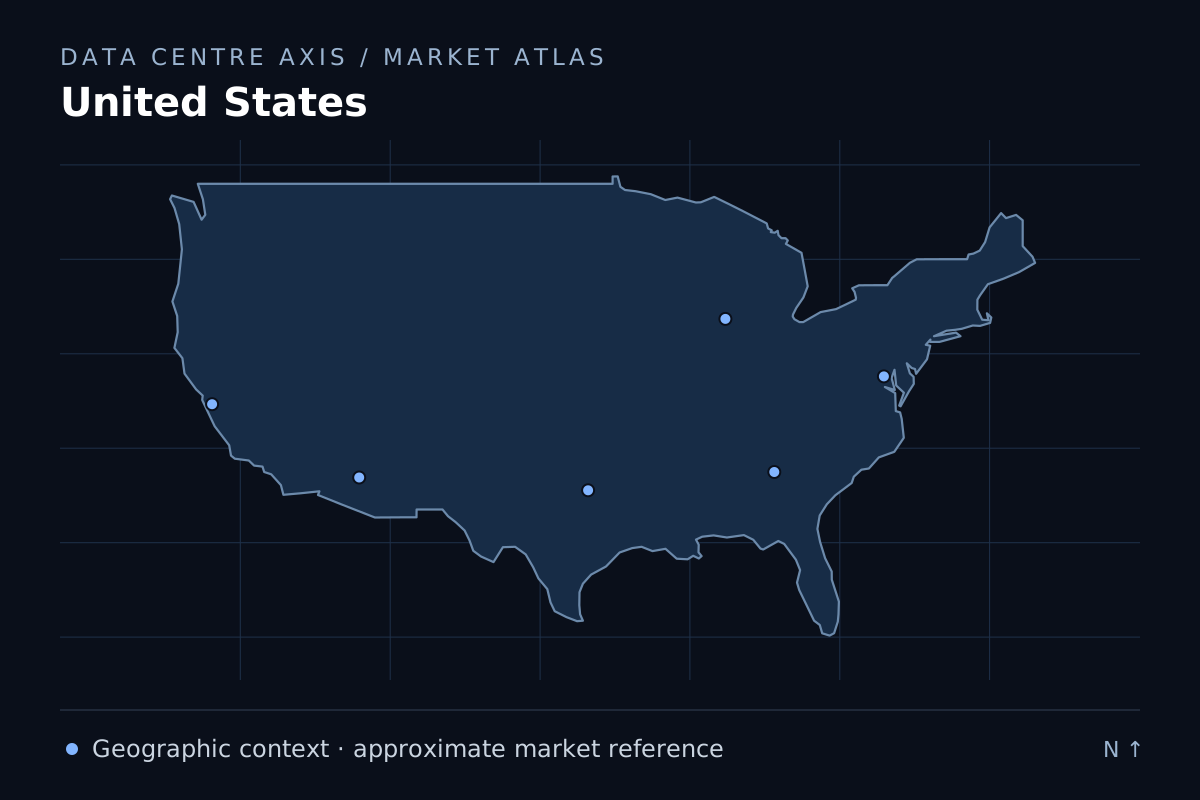
Colocation data center locations across the United States
Comparing United States data centers requires assessing power density, native cloud gateways and carrier diversity at the building and hall level:
- Northern Virginia: Digital Realty describes dense interconnection at its Northern Virginia sites (Digital Realty, 2026); ask which carriers and cloud connections serve the offered hall across Ashburn, Sterling and Reston.
- Dallas: At its operating Dallas - Plano data center, Flexential advertises designs supporting up to 80+ kW per cabinet and liquid cooling (Flexential, 2026); buyers should specify rack heat and cooling methods to confirm the offered hall supports them.
- Chicago: Across its operating Chicago campus, CoreSite lists on-site cloud on-ramps for Amazon, Azure, Google and Oracle, while its CH1 facility supports deployments from cabinets and cages to private suites (CoreSite, 2026); match deployment formats to the facility and confirm required cloud endpoints across the campus.
- Silicon Valley: Digital Realty offers colocation and connectivity across its Bay Area campuses in Santa Clara and San Jose (Digital Realty, 2026); confirm whether required connections terminate in the offered building.
- Atlanta: Compare Midtown, Downtown, West End and suburban Marietta facility addresses, verify whether cloud on-ramps use local cross-connects or off-site carrier transport, and check contracted IT load schedules against operational cooling limits.
- Phoenix: Facilities span Phoenix, Chandler, Mesa and Tempe. Verify exact building addresses, physical carrier presence in the meet-me room, contracted IT load versus day-one draw, and high-density heat rejection.
When resources are deployed in the same facility as an Amazon Web Services (AWS) Direct Connect location, the facility can provide a physical cross-connect between Direct Connect equipment and your resources (AWS, 2026). When comparing multiple markets, evaluate target end-user latency, native cloud gateways, carrier diversity and physical separation between primary and backup sites.
What to verify in US colocation data center offers
Before selecting a hall, compare dated operator proposals across four technical and commercial areas:
- Contracted power and rack density: Establish day-one operational draw alongside total contracted kilowatt (kW) or megawatt (MW) capacity reserved for expansion, and confirm whether high-density workloads require specialized liquid cooling operational in the offered data hall.
- Electrical resilience and SLAs: Verify how the facility configures uninterruptible power supply (UPS) battery backup, backup generators and electrical paths during equipment maintenance, and check uptime commitments, operating temperature limits and scheduled maintenance windows in the service-level agreement (SLA).
- Cloud on-ramps and meet-me room access: Confirm whether native cloud on-ramps sit directly on site or rely on transport across an external partner network, check which providers operate in the meet-me room, and review recurring cross-connect fees.
- Pricing and contract comparison: Request an itemized quote separating one-off installation charges from recurring monthly costs for space, power and network access. Compare allocated flat-rate versus metered power billing, annual escalation clauses and expansion terms across data center colocation pricing and wholesale data center colocation.
How we source US capacity and introduce tenants
We match enterprise, cloud and AI deployments to US facilities with the right critical IT load, cooling resilience and carrier connectivity, and introduce you directly to the operator. If you operate or develop US data centers with available halls or expansion phases, we introduce customers and anchor tenants or help you offer capacity to matched buyers. Where needed, our digital infrastructure consultants and partner agents provide transaction and technical support for technical, planning and legal requirements.
To source US capacity, share your requirement:
- Target metro markets and acceptable regional alternatives.
- Day-one power draw, reserved kW or MW capacity, and planned expansion stages.
- Space format (individual racks, private cage, or dedicated wholesale suite).
- Workload characteristics, rack density and thermal management requirements.
- Essential carriers, cloud on-ramps and cross-connect needs.
- Target delivery schedule.
Cloud connections and carrier access
Specify your cloud endpoints during procurement and ask the provider for the exact physical connection path between your deployment and each platform.
A cross-connect is a physical cable within the data centre linking customer hardware to a network carrier, another customer or a cloud gateway. When resources are deployed in the same facility as an Amazon Web Services (AWS) Direct Connect location, the facility can provide a physical cross-connect between Direct Connect equipment and your resources (AWS, 2026).
Ask whether the facility houses native cloud on-ramps directly on site, or relies on transport across an external partner network. In carrier-neutral facilities, confirm which providers operate in the meet-me room, the dedicated space where carriers connect, and check recurring cross-connect fees that influence colocation pricing.
Rack power, cooling and resilience requirements
Technical briefs must verify mechanical and electrical specifications before commercial negotiation:
- Contracted power and draw: Establish day-one operational draw alongside total contracted kilowatt (kW) capacity reserved for expansion.
- Rack power density: Determine whether standard cabinet densities suffice or whether workloads require specialised heat rejection.
- Cooling deployment: Confirm whether advanced systems like liquid cooling are operational in the offered data hall rather than planned as future campus capabilities.
- Electrical resilience: Ask how the facility configures uninterruptible power supply (UPS) backup battery power, backup generators and electrical paths during equipment maintenance.
- Service commitments: Check uptime commitments, operating temperature limits and scheduled maintenance windows within the service-level agreement (SLA), the provider’s contracted service commitments.
Large footprints should also evaluate private cages versus dedicated wholesale colocation halls.
Colocation pricing and contract comparison
Request an itemised quote that separates one-off installation charges from recurring monthly costs for space, power and network access.
Key commercial items to review in colocation pricing include:
- Power billing models: Ask whether power is billed as an allocated flat rate or metered on actual consumption, whether cooling overhead is added, and what infrastructure is included.
- Price escalation: Review annual escalation clauses, identifying whether adjustments are fixed percentages or tied to economic indexes.
- Expansion terms: Ask what future power and cabinet space the operator can contract, and on what schedule additional capacity can be delivered.
- Contract terms: Assess multi-year commitments against renewal rights and contracted service commitments.
US data center colocation questions
Which US colocation provider should I choose?
Selecting a provider depends on workload architecture, power density, cooling and network requirements. Evaluate each facility on its specific power availability, cooling infrastructure, cloud and carrier routes, physical access and proximity to your users.
Is cloud connectivity included in colocation?
Check what network connectivity is included in the contract and confirm whether your cloud platform connects on site or via a partner route. Where a facility lacks an on-site on-ramp, ask which carrier or network partner routes traffic to your target cloud region.
How do I confirm available capacity and delivery dates in a US facility?
Share your required kW or MW load, rack density, target metro and go-live date. We match your brief against suitable halls and obtain dated operator proposals confirming reserved power, designated space, cooling readiness and delivery schedules for side-by-side comparison.