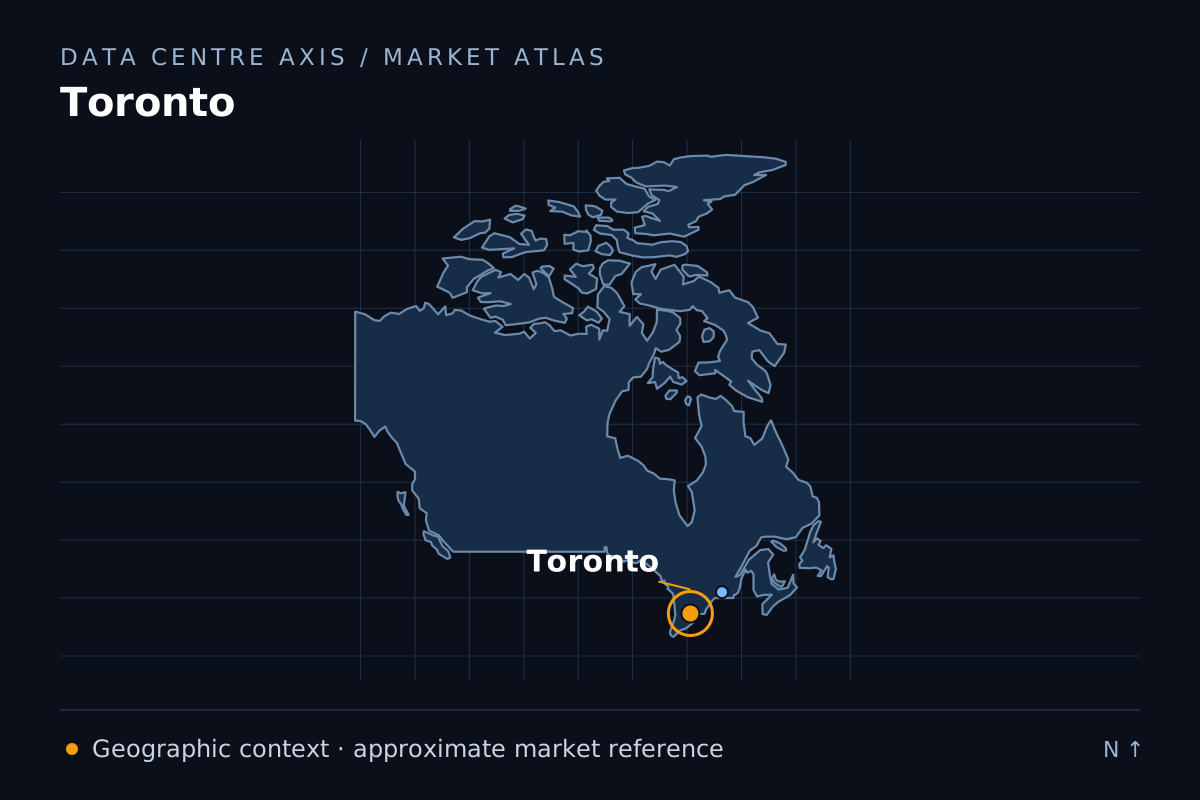
What you get when sourcing Toronto colocation capacity
We match your requirements against downtown Toronto interconnection hubs and suburban campuses so you can evaluate deliverable halls directly:
- A screened facility shortlist across downtown Toronto and Scarborough matched to your kW or MW load, rack density, carrier and cloud on-ramps, and target live date.
- Operator proposals compared side by side across power billing models, cooling configurations, cross-connect fees and expansion schedules.
- Direct introductions to operators with deliverable Toronto halls, or to AI, cloud and enterprise tenants if you are filling capacity.
Downtown Toronto and Scarborough facilities and submarkets
Evaluating Toronto colocation requires assessing properties on an individual building and hall basis, distinguishing financial-district interconnection hubs from Scarborough campuses:
- Downtown Toronto: Telehouse Canada lists its facility at 151 Front Street West (Telehouse Canada), and eStruxture lists the TOR-2 data centre at 145 King W, Toronto, ON, M5H 1J8 in the financial district (eStruxture).
- Scarborough: In Scarborough, which forms part of Toronto, eStruxture lists the TOR-4 data centre at 20 Pullman Court, Toronto, ON, M1X 1E4 (eStruxture).
Compare Toronto options against other provinces in our Canadian data centres directory and data centre colocation in Canada overview.
What to verify in Toronto colocation proposals
Sourcing teams comparing downtown Toronto and Scarborough proposals should verify four technical and commercial factors in writing:
- Power allocation basis: Ask providers to specify breaker or circuit ratings, contracted critical IT load in kW, any apparent power commitment in kVA for initial deployment and growth, and metered energy consumption in kWh, and confirm whether dense compute loads require specialized airflow management or liquid cooling.
- Network path diversity: Check available on-net network providers, meet-me room layout and building entry diversity, and confirm whether physical carrier, exchange and cloud connections terminate directly in the proposed data hall or rely on metro backhaul.
- Footprint scaling: Verify whether your initial rack, private cage or dedicated suite includes documented expansion options, or review wholesale data centre colocation options for multi-megawatt deployments.
- Commercial structure: Compare dated quotes across currency denominations, energy billing formulas, applicable taxes and non-recurring installation costs using our guide to data centre colocation pricing.
How we source Toronto colocation data centres
Tell us your target downtown Toronto or Scarborough location, required critical IT load in kW or MW, rack, cage or wholesale suite footprint, cooling requirements and planned operational date. We match colocation, wholesale and AI-ready capacity requirements with suitable operating facilities, compare operator proposals side by side, and introduce you directly to operators with matching halls.
Toronto colocation location selection
Evaluating Toronto colocation requires assessing physical properties on an individual facility basis rather than relying on generalised market assumptions. Key checks include verifying the exact building address, identifying the offered data hall or private room, and determining whether operational requirements favour downtown connectivity hubs or Scarborough campuses. Procurement teams should confirm physical access arrangements, equipment delivery routes, and how each operator accommodates rack specifications, contracted power and deployment milestones.
In downtown Toronto, Telehouse Canada lists its facility at 151 Front Street West (Telehouse Canada). Also situated in downtown Toronto’s financial district, eStruxture lists the TOR-2 data centre at 145 King W, Toronto, ON, M5H 1J8 (eStruxture). For any downtown deployment, buyers can ask operators whether physical carrier and cloud connections are delivered directly to the proposed data hall, rather than assuming connectivity paths or carrier presence.
In Scarborough, which forms part of Toronto, eStruxture lists the TOR-4 data centre at 20 Pullman Court, Toronto, ON, M1X 1E4 (eStruxture). When evaluating a Scarborough location, buyers should ask whether the facility aligns with their organisation’s specific deployment schedule, physical access needs, and internal disaster recovery requirements, without assuming regional resilience characteristics.
Technical and Commercial Evaluation Checks
Evaluating Toronto colocation space requires detailed operational verification before entering commercial commitments. Sourcing teams should examine primary engineering and commercial factors directly with operators:
- Power allocation basis: Ask providers to specify breaker or circuit ratings, contracted critical IT load in kW and any apparent power commitment in kVA for initial deployment and growth, metered energy consumption (in kWh), and the billing basis separately. Establish clear cooling metrics and confirm whether high-density compute loads require specialised airflow management or liquid cooling.
- Network path diversity: Determine available on-net network providers, meet-me room layout and building entry diversity. For requirements extending across Ontario or broader Canadian data centres, map external transit and backhaul routes between downtown hubs and secondary operating sites.
- Footprint scaling: Assess whether the initial deployment, whether a single full rack, private cage or dedicated suite, includes documented expansion options. Where power demands exceed retail colocation deployments, organisations can review wholesale capacity options.
- Commercial structure: Review dated quotes with specific questions regarding currency denominations, energy billing formulas, applicable taxes and non-recurring installation costs. Consult our overview of colocation pricing structures to support like-for-like comparison across proposals.
Toronto colocation questions
How do downtown Toronto facilities compare with Scarborough campuses?
Downtown facilities such as 151 Front Street West and 145 King Street West concentrate carrier peering, internet exchange access and cloud on-ramps in the financial district, while Scarborough facilities such as 20 Pullman Court offer multi-rack, cage and suite footprints with physical separation from the downtown core.
How should buyers verify cloud and carrier connectivity in a Toronto hall?
Ask the operator to confirm in writing whether your required carriers, internet exchanges and cloud on-ramps terminate directly inside the offered data hall via a physical cross-connect or require metro transport from a separate building.
What should a Toronto colocation brief include?
Specify whether your workload favours downtown Toronto or a suburban campus, your day-one and expansion kW or MW load, rack density and cooling requirements, essential carrier or exchange connections, and your target live date.